So I had to step away from this for a while. I wasn't happy with the way the posts were turning out. I had a piece written up for book III but I decided to re-write it from scratch so it was something that I was more comfortable with.
We're going to be trying something new going forward with this retrospective. Starting from now on for each story, I will put the title, the name of the main character, and the author in bold to make it easier to follow along.
This will be easier to do with the third book in the series which is substantially different from the previous two. Books 1 and 2 were essentially anthologies with interconnecting plot threads between the stories forming a single novel. Book 3 is formatted more like a traditional novel. Throughout the novel, the narrative switches perspective between eight different characters during the fortieth anniversary of the release of the Wild Card virus. Each of these changes in perspective is handled by a different writer. From this point on, books that set up story arcs in Wild Cards will be formatted like anthologies while the book that end those story arcs will be formatted like a more traditional novel.
The third book in the series deals with two major threats to the Wild Cards universe: one returning from the previous book and one relatively new. The returning threat is the Astronomer, the homicidal Ace, who is back for revenge against the Ace heroes who defeated him in book two. His return draws the attention of his arch nemesis, the tantric wizard Fortunato (written by Lewis Shiner) who must stop the Astronomer when he starts racking up a body count. On the other side of the equation, the Astronomer's henchwoman, Roulette (written by Melinda Snodgrass), gifted with the Ace ability that literally kills the men she seduces, is sent to assassinate Dr. Tachyon, the man she blames for her condition.
The new threat takes the form of the Shadow Fist Society, a criminal organization mentioned in previous books, but here showing itself for the first time. A coalition of various of street criminals, jokers, and aces, the organization is led by Kien Phuc, the arch-nemesis of the vigilante Yeoman. When a new character, Jennifer Malloy, the costumed thief known as Wraith (written by John Jospeh Miller) steals a ledger containing the Shadow Fist's ilicitdealing, she finds herself pursued by both the Fists and Yeoman, who wants the ledger for himself. In addition, gravity controlling, restaurateur Hiram Worchester (written by George RR. Martin), formerly the hero Fatman, find himself drawn into the conflict when the Shadow Fists begin running a protection racket against his restaurant's suppliers.
Meanwhile, the Shadow Fist's expanding territory has led to a war with the local mafia family, the Gambiones. Bagabond (written by Leanne C. Harper), the animal controlling Ace introduced in bBook 1, winds up involved in the conflict as her friend, Rosemarie Muldoon, the local district attorney, is secretly a member of the Gambione family. Complicating matters, the Shadow Fists hire the ace assassin James Spector, aka Demise (written by Walton Simons), who kills through eye contact, to take out the Gambione leadership. Tying it into the other plot threads, Demise is being pursued by his former employer, the Astronomer, who wishes to forcibly recruit him into his revenge scheme.
And, to cap things off, were-alligator Sewer Jack (written by Edward Bryant) is searching for his niece who has run away to New York City, intersecting with the other characters as he does so.
If that seems like a lot that's because it is. Later books using the novel format will be better at sticking to a central plotline, but this one is overstuffed with story, which leads it to have an unfocused feel to it. The Shadow Fists and the Astronomer make for formidable threats and the books high points are when it goes into full superhero action. The Astronomer bits especially raise the stakes as heroes introduced in book 1 are killed off, in ascending importance, leading to the a shocking scene that features the apparent death of a major character. By contrast, the subplot focusing on the Gambione family are kind of pointless and it's kind of a let down when after the climactic confrontation with the Astronomer we get several pages of low-rent Soprano's type drama. Mobsters just aren't that interesting in a world where super-villains plot world domination.
The book does do a good job in developing established characters. Walton Simons used this book started to transition Demise from an utter monster to more of a Wile E. Coyote-esque figure, who suffers incredible physical punishment over the course of the book to the point where it seems the universe itself is out to get him. It has humanizing effect on the character, making it easier to empathize with him, even though he is undoubtedly a terrible person. Meanwhile, we learn more about Sewer Jack, who may be one of the first positively portrayed gay characters in superhero fiction. And with Wraith, Wild Cards gets credit for introducing the rare heroine (or hero for that matter) whose not motivated by a dark and troubled past. (It's just kind of a shame she never got anymore stories).
Housekeeping Notes: This volume introduces several characters who will get stories in later volumes. Most notable of these are Billy Ray, a government employed ace with healing power and super strength, who winds up being used as a pawn by the Shadow Fists. We finally see Jay Ackroyd, aka Poppinjay, a private detective with teleporting abilities who was mentioned in the previous volume. We also meet Fadeout, a Shadow Fist member with the power to turn invisible, who will get a single story in an upcoming volume. One character who will return as a prominent antagonist is St. John "Loophole" Latham, the Shadow Fists corrupt attorney. Finally, both "Digger" Downs, an unscrupulous reporter, and Father Squid, the religious leader of Jokertown, who play larger roles in later books are introduced here.
Wednesday, November 28, 2018

Sunday, November 11, 2018
Tales from the Bargain Bin: "The Town That Forgot How to Breathe" should really take up breathing exercises
So since, I had a lot of fun with the last Tales From the Bargain Bin I decided to do one more. As I said last time, this review series is about reviewing books that I've 1) read at least one year ago that 2) also aren't very good 3)(almost) entirely from memory. But this time, I'm going back further then one year. I'm going back almost seven years.
Since in my last article, I picked on a book whose politics I profoundly disagreed with, this time I'm going to pick on a book whose politics are closer to my own. At least to the extent that the books politics are, you know, "Gee, guys. Pollution and disrespect for nature really are bad aren't they."
This bring me to "The Town that Forgot How to Breathe", a book which, at the least, has it's heart in the right place. You could feel that the writer cared passionately about the environment. It's just a shame that he had to stop what could have been a really interesting story to be preachy.
The premise would not be out of place in a horror movie and indeed the first part of the book plays about much like a Stephen King novel. The main character is a recently divorced father who brings his young daughter to that oldest of horror tropes: a small town with a secret. In this case, the town is a settlement in Canada with a history of fairy sightings and more recently, the dissapearance of a local father and his daughter.
Our protagonist, Generic Protagonist, soon befriends the mother of the missing girl who is dealing with problems of our own. Mainly, she is seeing apparitions of her husband and their daughter. Is this haunting connected to the mysterious plague causing the town's residents to asphyxiate?
The answer is maybe? Kind of? The book is pretty vague on that point. There's nothing wrong with ambiguity in favor of a good story. Unfortunately, this is not a good story: it's a weird technophobic screed about the evils of technology. SPOILERS from this point on:
The answer to all the supernatural goings on turn out to be that human activity has screwed up the connection between the town and the world of the faeries. This has created the supernatural equivalent of intestinal blockage, and the strange happenings are a magic enema, creating a torrent of magical diarrhea so that everything can be set right. (That metaphor may have gotten away from me).
By the way, the human activity that causes all this chaos: Putting up power lines. Not pollution. Not overuse of natural resources (indeed, the townspeople's overfishing is treated sympathetically). No: it's just the use of electricity. Because technology is the devil and the we should all go back to before the time of indoor plumbing and live in the trees.
Look, I try to be environmentally conscious but it's not an either or situation. There are going to need to be some tough decisions made about the overuse of technology in the future but it doesn't mean that we should give up all the technological advances of the last several centuries.
Also, the book treatment of the ghosts is really messed up. It's implied that the father murdered the daughter and killed himself. But that's ok because they're happy being ghosts. That's a really uncomfortable minimization on child abuse by any standard.
Looking at the book's Amazon page , they changed the cover in an attempt to mark it as more of a horror novel. But this book is at best a mediocre literary novel with some horror elements. The sad thing is that there are some effective scare scenes. If this book had just stuck to ripping of Stephen King, it might actually have been good.
Since in my last article, I picked on a book whose politics I profoundly disagreed with, this time I'm going to pick on a book whose politics are closer to my own. At least to the extent that the books politics are, you know, "Gee, guys. Pollution and disrespect for nature really are bad aren't they."
This bring me to "The Town that Forgot How to Breathe", a book which, at the least, has it's heart in the right place. You could feel that the writer cared passionately about the environment. It's just a shame that he had to stop what could have been a really interesting story to be preachy.
The premise would not be out of place in a horror movie and indeed the first part of the book plays about much like a Stephen King novel. The main character is a recently divorced father who brings his young daughter to that oldest of horror tropes: a small town with a secret. In this case, the town is a settlement in Canada with a history of fairy sightings and more recently, the dissapearance of a local father and his daughter.
Our protagonist, Generic Protagonist, soon befriends the mother of the missing girl who is dealing with problems of our own. Mainly, she is seeing apparitions of her husband and their daughter. Is this haunting connected to the mysterious plague causing the town's residents to asphyxiate?
The answer is maybe? Kind of? The book is pretty vague on that point. There's nothing wrong with ambiguity in favor of a good story. Unfortunately, this is not a good story: it's a weird technophobic screed about the evils of technology. SPOILERS from this point on:
The answer to all the supernatural goings on turn out to be that human activity has screwed up the connection between the town and the world of the faeries. This has created the supernatural equivalent of intestinal blockage, and the strange happenings are a magic enema, creating a torrent of magical diarrhea so that everything can be set right. (That metaphor may have gotten away from me).
By the way, the human activity that causes all this chaos: Putting up power lines. Not pollution. Not overuse of natural resources (indeed, the townspeople's overfishing is treated sympathetically). No: it's just the use of electricity. Because technology is the devil and the we should all go back to before the time of indoor plumbing and live in the trees.
Look, I try to be environmentally conscious but it's not an either or situation. There are going to need to be some tough decisions made about the overuse of technology in the future but it doesn't mean that we should give up all the technological advances of the last several centuries.
Also, the book treatment of the ghosts is really messed up. It's implied that the father murdered the daughter and killed himself. But that's ok because they're happy being ghosts. That's a really uncomfortable minimization on child abuse by any standard.
Looking at the book's Amazon page , they changed the cover in an attempt to mark it as more of a horror novel. But this book is at best a mediocre literary novel with some horror elements. The sad thing is that there are some effective scare scenes. If this book had just stuck to ripping of Stephen King, it might actually have been good.
Monday, July 24, 2017
Tales from the Bargain BIn - Or how I learned to stop worrying and hate "Forge of the Elders"
We're going to try something new today, faithful blog readers. (OK, reader). We assume that most other book reviewers carefully read each book and turn their reviews in after they've read the book. Maybe they wait a few hours to digest what they've read. Maybe they take notes on the book's plot and themes while their reading. That way they know that their not getting plot details wrong when they sit down to right.
But not all book are created equal. That are some books that are so bad, so painful to read that they simply don't deserve the same level of thought one would put into a review of the classics of literature like The Great Gatsby, Hamlet, and of course, I Was A White Trash Zombie. Some books need a taking down by some one who not only doesn't remember the details right but doesn't actually care. That's why I'm giving you a new column called "Tales from the Bargain Bin", a review of terrible books that I bought on the cheap and read some years ago. Because these books really do deserve it...
 So to start with we're going to start with libertarian SF writer's, L Neil Smith's novel/manifesto Forge of the Elders. Now, I must admit that I don't share Smith's politics and I worried time that my hatred for this book had something to do with this. Then, I read the Illuminatus trilogy which advocates for anarchy and AE Van Vogt's The Mind Cage which appears to come out in favor of monarchy and dictatorship and I liked both of them. So it's not the shaky politics that I found revolting about Forge of the Elders.
But, let's start with what's good about the book. It has a nice cover. A really, really nice cover. Painted with rich colors, lots off detail, shows the characters, gives the reader an idea of the book's plot. They just don't make covers like that anymore.
Now to the things that are not so good namely, the plot, the characters, the writing. The plot is set in the far future where America has been taken over by the Soviet Union. (Which is actually pretty prescient come to think of it). A group of political undesirables are assigned to a space mission to harvest the resources of an asteroid to help sustain the soviet state.
Unfortunately, mostly for the reader, the asteroid is occupied by a group of humans and animal people from a parallel universe. These animal people are led by the titular Elders, a group of giant libertarian squids. Among the asteroid dwellers is our hero, the human Eichra Oran (I don't know if I'm spelling that correctly and I don't care), one of those Randian Ubermensch types who is so perfect and heroic that you kind of find yourself rooting for the villains.
Here's a summary of the story:
CREWMAN: I have doubts about the Communist system but I am afraid to voice them.
EZRA ORTAN: Libertarianism is awesome. You should be a libertarian. Have I mentioned that I am a libertarian today? Libertarian.
TALKING DOG SIDEKICK: I'm a talking dog sidekick.
EVERY MAJOR FEMALE CHARACTER: Oh, Edrard Onan, you're so manly. I must sleep with you.
SHIP'S MORALE OFFICER: I'm a hardline communist. I hate you, Eckhardt Oman. However, the fact that I am clearly a moron who is not qualified to run an Arby's should make it obvious that I am not the main antagonist and will see the error of my way at the end of the book.
EVIL RUSSIAN CYBORG TRILOBITE MAN: I am the main antagonist. I'm poorly explained and literally come out of nowhere.
READER: Could- could this book be about the Evil Russian Cyborg Trilobite Man instead?
So, yeah, there you have it a book hundreds of a pages long whose only selling point is a character who literally only show up in the last few chapters. All the rest of the book is basically indistinguishable from reading a political pamphlet passed out by an unhinged man. In fact, reading the pamphlet might actually be less of a waste of your time.
But not all book are created equal. That are some books that are so bad, so painful to read that they simply don't deserve the same level of thought one would put into a review of the classics of literature like The Great Gatsby, Hamlet, and of course, I Was A White Trash Zombie. Some books need a taking down by some one who not only doesn't remember the details right but doesn't actually care. That's why I'm giving you a new column called "Tales from the Bargain Bin", a review of terrible books that I bought on the cheap and read some years ago. Because these books really do deserve it...
But, let's start with what's good about the book. It has a nice cover. A really, really nice cover. Painted with rich colors, lots off detail, shows the characters, gives the reader an idea of the book's plot. They just don't make covers like that anymore.
Now to the things that are not so good namely, the plot, the characters, the writing. The plot is set in the far future where America has been taken over by the Soviet Union. (Which is actually pretty prescient come to think of it). A group of political undesirables are assigned to a space mission to harvest the resources of an asteroid to help sustain the soviet state.
Unfortunately, mostly for the reader, the asteroid is occupied by a group of humans and animal people from a parallel universe. These animal people are led by the titular Elders, a group of giant libertarian squids. Among the asteroid dwellers is our hero, the human Eichra Oran (I don't know if I'm spelling that correctly and I don't care), one of those Randian Ubermensch types who is so perfect and heroic that you kind of find yourself rooting for the villains.
Here's a summary of the story:
CREWMAN: I have doubts about the Communist system but I am afraid to voice them.
EZRA ORTAN: Libertarianism is awesome. You should be a libertarian. Have I mentioned that I am a libertarian today? Libertarian.
TALKING DOG SIDEKICK: I'm a talking dog sidekick.
EVERY MAJOR FEMALE CHARACTER: Oh, Edrard Onan, you're so manly. I must sleep with you.
SHIP'S MORALE OFFICER: I'm a hardline communist. I hate you, Eckhardt Oman. However, the fact that I am clearly a moron who is not qualified to run an Arby's should make it obvious that I am not the main antagonist and will see the error of my way at the end of the book.
EVIL RUSSIAN CYBORG TRILOBITE MAN: I am the main antagonist. I'm poorly explained and literally come out of nowhere.
READER: Could- could this book be about the Evil Russian Cyborg Trilobite Man instead?
So, yeah, there you have it a book hundreds of a pages long whose only selling point is a character who literally only show up in the last few chapters. All the rest of the book is basically indistinguishable from reading a political pamphlet passed out by an unhinged man. In fact, reading the pamphlet might actually be less of a waste of your time.
Monday, June 12, 2017
Wild at Heart- A Wild Card's Retrospective- Book 2: Aces High Part 2
Having looked at the interstitial stories in the previous post, we start our look at the one-off stories with a look at science-fiction grand master Roger Zelazny's contribution to this volume. Unfortunately, like his last contribution, it's the low point of the book.
Zelazny's story, "Ashes to Ashes", continues a plot thread introduced in the interstitial story "Jube" where Jube hires Zelazny's recurring anti-hero, Croyd Crenson, aka the Sleeper, to steal the body of the alien who was killed by the Swarm. Along the way, Croyd discovers that other parties want the body for themselves and have hired another mercenary to find it.
It's harder to put my finger on why this story didn't work for me. Unlike Zelazny's previous Wild Cards story, "The Sleeper", which very little happens, in this story, I felt that almost too much happened. Where as "The Sleeper" gave Croyd a lot of potentially interesting character threads, but ultimately did nothing with them, here we get almost no sense of what drives Croyd at all. He's just another generic lovable rogue, one of a million similar characters who inhabit the realms of fiction, which ultimately makes the story fall flat.
Next up is the story "If Looks Could Kill" by Walton Simons, which is our obligatory villain-story for this volume. This story introduces one of the Wild Cards Universe's long-running villains, James Spector aka Demise. An accountant whose Wild Card virus killed him, an emergency procedure returned him to life with the ability to literally kill people through eye contact.
The story is fairly straight-forward: Demise, on the run for murder, winds up being recruited by the Astronomer to act as an assassin. Demise himself is not a particularly engaging character in his first appearance. He will become a more complex character in the later books but here he is a psychopath and misogynist who revels in killing. The story is notable, primarily, for a rather shocking human sacrifice sequence which shows just how messed up both Demise and the Astronomer really are. Unfortunately, it's sole purpose seems really just to show us that the bad guys are in fact bad guys, something we already know from reading the earlier stories in this book.
The next story "Winter's Chill", written by Martin himself, is a short character piece focusing on Thomas Tudbury aka the Turtle, which is the book's highlight. Although it very slightly advances the overarching plot, the story mostly deals with the emotional fall-out of the Turtle's old flame getting re-married. Twenty years have passed for the character since we last saw him and his life has not been going great. The Turtle's popularity as a hero has been eclipsed by those who came after him and he feels taken for granted. Meanwhile, as Tom Tudbury, he has become riven by insecurities, living alone and unable to use his great powers outside of his Turtle shell. "Winter's Chill" is ultimately a tragedy about how even super-heroes can have their lives torn apart, not by a villain, but by their own self-loathing.
The Turtle's insecurities continue in the story "Relative Difficulties" by Melinda M. Snodgrass which sees him team up with Dr. Tachyon and Mark Meadows from the previous book to fend off Tachyon's people, the Takisians, who have returned to take their errant prince home in the wake of the Swarm invasion. Although nominally about Tachyon's relationship with his people and family, this story is more about re-introducing Mark Meadows and showing off his array of super-powers.
 In the previous book, Meadows may have briefly changed into a hero called the Radical under the influence of LSD. In Book Two, we learn that his attempts to become the Radical again have largely met with failure. Instead, Meadows has become Captain Trips, a drug-fueled riff on Dial H For Hero (or Ben 10 for any millenials reading this). By taking different mixtures of drugs, Trips can turns into (or switch places with) five distinct heroes for an hour at a time, each with their own powers, memories, and personality.
The next story "With A Little Help from His Friends", by Victor Milan, is basically a retread of "Relative Difficulties". The Takisians return for round two and Tachyon and Trips (minus the Turtle this time) have to stop them. It does, however, introduce my favorite Trips alter-ego: Starshine, a well-meaning oaf prone to lectures on the evils of capitalism and composing poetry at inappropriate times. (He's right about a lot of what he says but he tends to do it when he should be focusing on the crisis at hand). Ultimately, because both "With a Little Help from His Friends" and "Relative Difficulties" are really a chance to showcase most of Trips' alter-egos, they work best as straight action stories. They are both fine in that respect although "Friends" seems a little redundant as it covers most of the same territory as "Relative Difficulties."
The heroes' final confrontation (for this book, anyway) with the Astronomer comes in "By Lost Ways" by Pat Cadigan. This story introduces the new ace, Jane Lillian Dow a.k.a. Water Lily blessed with ability to control water. Making her way to New York with the hopes of becoming a celebrity ace, she quickly finds herself kidnapped by the Masons. Although "By Lost Ways" concludes with a big superhero battle, it is largely hampered by being from the perspective of Water Lilly. This is a problem as she is the book's only female lead and she spends most of that time as a hostage, relying on others to rescue her, not really showing any agency until the very end of the story. And having read the later book in the series, I can say the character will only get worse from here, not better.
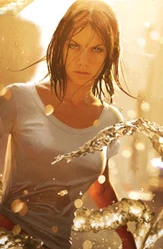 The amusing "Mr. Koyama's Comet" by Walter John Williams is basically a short piece about an egotistical amateur astronomer (no pun intended) that largely serves to set up the final salvo of the Swarm invasion. That salvo comes in "Half Past Dead" by John J. Miller, where the non-super powered vigilante Yeoman winds up having to team up with Dr. Tachyon, Fortunato, and Mai, an ace healer, to defeat the Swarm.
This story gets credit for having a better ending than just destroying the big alien monster and further points for having that ending set up in the pervious book. It looses points for mostly beings an excuse for putting the Yeoman character in the book. Despite the contrivances to justify Yeoman's presence, with all the powerful aces Tachyon knows, it really doesn't make sense to recruit the character who has no powers other than archery skills to save the world. There's a reason, after all, that Hawkeye is the least believable Avenger.
Aces High is the first time the series had an overarching plotline throughout one book and, while the stories are inconsistent, the book showed it could be done. All thing being equal, the book does a good job setting up plot threads and then continuing through multiple stories by different writers. The overarching invasion plotline is advanced in each story and the book does manage to bring it all together into what I found to be a satisfying conclusion.
Ultimately, if the first book was about introducing the characters and their world, the second book is about showing the status quo of the Wild Cards universe. Of the early books in the series, this one is the most like a standard super-hero story: Heroes fight villains, hero wins, repeat as necessary. In the end, the major characters are all in place for the next book, ready for round two. Unfortunately for them, Book Three is coming and not everyone is going to get out unscathed...
Zelazny's story, "Ashes to Ashes", continues a plot thread introduced in the interstitial story "Jube" where Jube hires Zelazny's recurring anti-hero, Croyd Crenson, aka the Sleeper, to steal the body of the alien who was killed by the Swarm. Along the way, Croyd discovers that other parties want the body for themselves and have hired another mercenary to find it.
It's harder to put my finger on why this story didn't work for me. Unlike Zelazny's previous Wild Cards story, "The Sleeper", which very little happens, in this story, I felt that almost too much happened. Where as "The Sleeper" gave Croyd a lot of potentially interesting character threads, but ultimately did nothing with them, here we get almost no sense of what drives Croyd at all. He's just another generic lovable rogue, one of a million similar characters who inhabit the realms of fiction, which ultimately makes the story fall flat.
Next up is the story "If Looks Could Kill" by Walton Simons, which is our obligatory villain-story for this volume. This story introduces one of the Wild Cards Universe's long-running villains, James Spector aka Demise. An accountant whose Wild Card virus killed him, an emergency procedure returned him to life with the ability to literally kill people through eye contact.
The story is fairly straight-forward: Demise, on the run for murder, winds up being recruited by the Astronomer to act as an assassin. Demise himself is not a particularly engaging character in his first appearance. He will become a more complex character in the later books but here he is a psychopath and misogynist who revels in killing. The story is notable, primarily, for a rather shocking human sacrifice sequence which shows just how messed up both Demise and the Astronomer really are. Unfortunately, it's sole purpose seems really just to show us that the bad guys are in fact bad guys, something we already know from reading the earlier stories in this book.
The next story "Winter's Chill", written by Martin himself, is a short character piece focusing on Thomas Tudbury aka the Turtle, which is the book's highlight. Although it very slightly advances the overarching plot, the story mostly deals with the emotional fall-out of the Turtle's old flame getting re-married. Twenty years have passed for the character since we last saw him and his life has not been going great. The Turtle's popularity as a hero has been eclipsed by those who came after him and he feels taken for granted. Meanwhile, as Tom Tudbury, he has become riven by insecurities, living alone and unable to use his great powers outside of his Turtle shell. "Winter's Chill" is ultimately a tragedy about how even super-heroes can have their lives torn apart, not by a villain, but by their own self-loathing.
The Turtle's insecurities continue in the story "Relative Difficulties" by Melinda M. Snodgrass which sees him team up with Dr. Tachyon and Mark Meadows from the previous book to fend off Tachyon's people, the Takisians, who have returned to take their errant prince home in the wake of the Swarm invasion. Although nominally about Tachyon's relationship with his people and family, this story is more about re-introducing Mark Meadows and showing off his array of super-powers.
The next story "With A Little Help from His Friends", by Victor Milan, is basically a retread of "Relative Difficulties". The Takisians return for round two and Tachyon and Trips (minus the Turtle this time) have to stop them. It does, however, introduce my favorite Trips alter-ego: Starshine, a well-meaning oaf prone to lectures on the evils of capitalism and composing poetry at inappropriate times. (He's right about a lot of what he says but he tends to do it when he should be focusing on the crisis at hand). Ultimately, because both "With a Little Help from His Friends" and "Relative Difficulties" are really a chance to showcase most of Trips' alter-egos, they work best as straight action stories. They are both fine in that respect although "Friends" seems a little redundant as it covers most of the same territory as "Relative Difficulties."
The heroes' final confrontation (for this book, anyway) with the Astronomer comes in "By Lost Ways" by Pat Cadigan. This story introduces the new ace, Jane Lillian Dow a.k.a. Water Lily blessed with ability to control water. Making her way to New York with the hopes of becoming a celebrity ace, she quickly finds herself kidnapped by the Masons. Although "By Lost Ways" concludes with a big superhero battle, it is largely hampered by being from the perspective of Water Lilly. This is a problem as she is the book's only female lead and she spends most of that time as a hostage, relying on others to rescue her, not really showing any agency until the very end of the story. And having read the later book in the series, I can say the character will only get worse from here, not better.
The amusing "Mr. Koyama's Comet" by Walter John Williams is basically a short piece about an egotistical amateur astronomer (no pun intended) that largely serves to set up the final salvo of the Swarm invasion. That salvo comes in "Half Past Dead" by John J. Miller, where the non-super powered vigilante Yeoman winds up having to team up with Dr. Tachyon, Fortunato, and Mai, an ace healer, to defeat the Swarm.This story gets credit for having a better ending than just destroying the big alien monster and further points for having that ending set up in the pervious book. It looses points for mostly beings an excuse for putting the Yeoman character in the book. Despite the contrivances to justify Yeoman's presence, with all the powerful aces Tachyon knows, it really doesn't make sense to recruit the character who has no powers other than archery skills to save the world. There's a reason, after all, that Hawkeye is the least believable Avenger.
Aces High is the first time the series had an overarching plotline throughout one book and, while the stories are inconsistent, the book showed it could be done. All thing being equal, the book does a good job setting up plot threads and then continuing through multiple stories by different writers. The overarching invasion plotline is advanced in each story and the book does manage to bring it all together into what I found to be a satisfying conclusion.
Ultimately, if the first book was about introducing the characters and their world, the second book is about showing the status quo of the Wild Cards universe. Of the early books in the series, this one is the most like a standard super-hero story: Heroes fight villains, hero wins, repeat as necessary. In the end, the major characters are all in place for the next book, ready for round two. Unfortunately for them, Book Three is coming and not everyone is going to get out unscathed...
Friday, May 26, 2017
Wild at Heart- A Wild Card's Retrospective- Book 2: Aces High Part 1
If Wild Cards Book I was about setting up the world and characters, then Wild Card Volume II - Aces High was about showing that the world's and characters could be used to tell a singular story line. Unlike the first book, a single narrative thread bind all the stories: an alien invasion of Earth.
The book begin in 1979 where we found out what everybody's favorite tantric magician, Fortunato, has been up to since the first book in a story called "Pennies from Hell", written by Lewis Shiner. The answer to that question turns out to be continuing his vendetta against the cult he antagonized in Book I which are revealed to be a branch of the Egyptian Masons.
This story introduces a running theme of Fortunato's character arc: the fact that his actions tend to have unintended consequences to the people closest to him. The realization of this clashes with the character's fundamentally selfish attitude towards life, driving much of his internal conflict going forward. That being said, the sexual nature of Fortunato's powers comes off as trying to hard to shock and ends up just being silly. Reading the scene at the end of "Pennies from Hell", where Fortunato (apparently) destroys the Masons, the details of which I will mercifully spare you, prompted a snicker when I first read the book as a teenager and time has not made it any less silly.
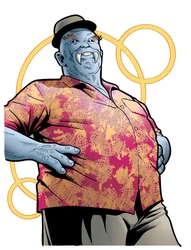 The book jumps ahead to 1985 to two interstitial stories, "Jube" (uncredited) and "Unto the Sixth Generation" by Walter John Williams. Starting with this book, Wild Cards novels contained interstitial stories divided into multiple chapters throughout the book and advancing the book's overarching plot. These stories contrast with individual stories which takes up a single chapter.
In this case, the two stories share an inciting incident: A dying alien arrives on Earth with an experimental teleportation device with a warning of an oncoming invasion by a race of world devouring aliens called the Swarm. "Jube" tells the story one of the alien's associates, Jube the Walrus, a newsboy who appears to be a deformed joker, but is in fact an alien himself: an agent planted by a group of space trader know as the Network to spy on the Wild Cards. Jube spends most of the book trying to build a device to call the Network to summon help to fight off the Swarm.
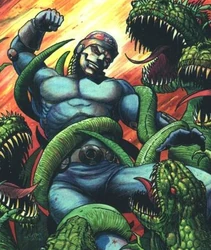 "Unto the Sixth Generation" introduces a new hero, the android Modular Man, created by Dr. Maxim Travnicek, an ace whose ability make him a gifted inventor. Being a self-obsessed misanthrope, Travnicek has designs on fame and programs Modular Man to fight crime as part of a plan to get rich by selling androids to the military. Quickly becoming a celebrity, Modular Man is accepted into the ace community, and as a result gets a front-row seat for the Swarm invasion.
Both Jube and Modular Man were good choices for protagonists as they are both likable characters. In Jube's case, the idea of an alien passing as a disfigured human is a clever one. Furthermore, he is the rare Wild Cards character who simply has a good heart. He cares about other people and the character's ernest desire to save Earth is endearing even if his story ultimately comes to a rather cynical conclusion.
Modular Man is another character who is basically a good person. Unlike android comic-book heroes, like the Vision or the Red Tornado, who Modular Man owes a clear debt to, fitting in with humanity proves to be the easy part. Modular Man loves life and embraces it fully. Like many characters in the series, Modular Man is a womanizer who likes alcohol. Unlike the other characters, this doesn't come of as much as a character flaw but rather as a side effect of the character's sheer joy d'vivre. Its hard to hate some one who enjoys life so much. The character's real conflict comes from the dawning realization that he is essentially enslaved by his creator, Dr. Travnicek.
Modular Man's story, "Unto the Sixth Generation" is the story that focuses more on super-hero action with several genuinely suspenseful fight scenes. It also has the honor of introducing the story's major human villain, The Astronomer, the leader of the Egyptian Masons who survived Fortunato's assault in the first story and has his own reasons for wanting the Swarm to invade. He's also an old man in a wheel chair so how terrifying could he possibly be?
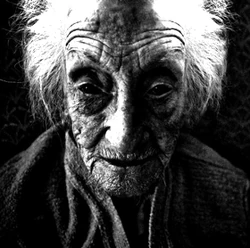
-- Oh. That terrifying. Despite his age, the Astronomer is a particularly nasty villain. His ace ability grants him incredible psychic powers which he charges by killing people, which he does in several sequences that are not for the faint of heart. He is unsettling because, while he is clearly a psychopath, he is also a master planner. His evil plan is genuinely clever, which give the story a villain that seems like a genuine threat, no easy feet for a book with so many powerful heroes.
In part two, we'll explore the individual stories and catch up with Wild Cards mainstays like Dr. Tachyon and the Turtle.
The book jumps ahead to 1985 to two interstitial stories, "Jube" (uncredited) and "Unto the Sixth Generation" by Walter John Williams. Starting with this book, Wild Cards novels contained interstitial stories divided into multiple chapters throughout the book and advancing the book's overarching plot. These stories contrast with individual stories which takes up a single chapter.In this case, the two stories share an inciting incident: A dying alien arrives on Earth with an experimental teleportation device with a warning of an oncoming invasion by a race of world devouring aliens called the Swarm. "Jube" tells the story one of the alien's associates, Jube the Walrus, a newsboy who appears to be a deformed joker, but is in fact an alien himself: an agent planted by a group of space trader know as the Network to spy on the Wild Cards. Jube spends most of the book trying to build a device to call the Network to summon help to fight off the Swarm.
"Unto the Sixth Generation" introduces a new hero, the android Modular Man, created by Dr. Maxim Travnicek, an ace whose ability make him a gifted inventor. Being a self-obsessed misanthrope, Travnicek has designs on fame and programs Modular Man to fight crime as part of a plan to get rich by selling androids to the military. Quickly becoming a celebrity, Modular Man is accepted into the ace community, and as a result gets a front-row seat for the Swarm invasion.Both Jube and Modular Man were good choices for protagonists as they are both likable characters. In Jube's case, the idea of an alien passing as a disfigured human is a clever one. Furthermore, he is the rare Wild Cards character who simply has a good heart. He cares about other people and the character's ernest desire to save Earth is endearing even if his story ultimately comes to a rather cynical conclusion.
Modular Man is another character who is basically a good person. Unlike android comic-book heroes, like the Vision or the Red Tornado, who Modular Man owes a clear debt to, fitting in with humanity proves to be the easy part. Modular Man loves life and embraces it fully. Like many characters in the series, Modular Man is a womanizer who likes alcohol. Unlike the other characters, this doesn't come of as much as a character flaw but rather as a side effect of the character's sheer joy d'vivre. Its hard to hate some one who enjoys life so much. The character's real conflict comes from the dawning realization that he is essentially enslaved by his creator, Dr. Travnicek.
Modular Man's story, "Unto the Sixth Generation" is the story that focuses more on super-hero action with several genuinely suspenseful fight scenes. It also has the honor of introducing the story's major human villain, The Astronomer, the leader of the Egyptian Masons who survived Fortunato's assault in the first story and has his own reasons for wanting the Swarm to invade. He's also an old man in a wheel chair so how terrifying could he possibly be?
-- Oh. That terrifying. Despite his age, the Astronomer is a particularly nasty villain. His ace ability grants him incredible psychic powers which he charges by killing people, which he does in several sequences that are not for the faint of heart. He is unsettling because, while he is clearly a psychopath, he is also a master planner. His evil plan is genuinely clever, which give the story a villain that seems like a genuine threat, no easy feet for a book with so many powerful heroes.
In part two, we'll explore the individual stories and catch up with Wild Cards mainstays like Dr. Tachyon and the Turtle.
Monday, April 17, 2017
Rue Morgue Reading - "Skin" was probably pretty shocking back in the day
The great thing about the Rue Morgues list of the top 100 horror novels is that it drew from several hundred years of material. In fact, The Monk, the oldest book in the series was written in the eighteenth century. Ironically, while The Monk has aged pretty well over the centuries, Kathe Koja's Skin, published in 1992, has not.
 This is not to say that it's a bad book. In fact, Skin has compelling characters , a fascinating plot, and deals with extreme body modification, a subject that is always ripe for horror. (If you don't believe me, just look at the extreme piercings and ritual self-mutilations of the Cenobites from the Hellraiser series of films). It's just not really scary which is kind of bad news for a book that bills itself as "psychological horror."
But I'm getting ahead of myself. Skin, at it's heart, is a story about Tess Bajac, a struggling metalworker who wields together mechanical sculpture. Her artwork attracts the attention of Bibi, an aspiring dancer, who draws Tess into using her talents as part of a performing art group. However, it becomes clear over time that Bibi is mentally ill and has an obsession with self-mutilation that leads her to modify her own body in unhealthy ways though piercings and surgeries. Add into this the Svengali-like Micheal who exert influences over both of the female leads, we have a volatile mix ready to explode.
--Only it never quite does. All throughout the book, we are left with the idea that a something is going to go horribly wrong. But when it does, once in the middle of the book and once again at the end, it turns out to be nothing you wouldn't find in any conventional thriller novel. To put it in perspective, there are James Patterson novels that are more horrific than anything that happens in Skin.
Then, if the action is not the source of horror, then it must come from the psychological states of the characters. Unfortunately, that's not scary either. Tess, the point-of-view character, certainly has issues but she is also a decent person who has relationships with toxic people. As a heroine, she is ultimately too likable for her mental problems to elicit horror. Bibi is too dysfunctional to be sympathetic and Michael is deliberately supposed to be unlikable. As a result, the story comes off as a tragedy about relationships, and not necessarily a bad one, but again ultimately not a horror story.
Then, the only remaining source of horror could be the physical transformation that Bibi practices on herself as she is driven increasingly to modify her body. But again, while certainly not something a healthy person would do to themselves, it never gets to the point where it becomes scary.
I think that a lot of it has to do with the age of the book. Back when it was written, the idea of voluntary surgical body modification was unexplored in popular culture and the people who practiced it were largely an unseen subgroup. Unfortunately, the last few years have resulted in a surge of horror movies regarding surgical body modification with granddaddy of them all being the Human Centipede films, a film series with a premise so disturbing I can't even bring myself to watch them. Furthermore, real people with extreme body modifications began appearing on the public's radar thanks to reality television and online news providers need for click bait. (Google "Lizardman" if you don't believe me). In today's world, the modifications described in Skin, wile still off-putting, just aren't as disturbing as they were when the book was written.
In the end, I'd say give this book a read if you're a fan of tragedy or relationship drama but if you go in expecting horror, expect to be disappointed
.
 This is not to say that it's a bad book. In fact, Skin has compelling characters , a fascinating plot, and deals with extreme body modification, a subject that is always ripe for horror. (If you don't believe me, just look at the extreme piercings and ritual self-mutilations of the Cenobites from the Hellraiser series of films). It's just not really scary which is kind of bad news for a book that bills itself as "psychological horror."
But I'm getting ahead of myself. Skin, at it's heart, is a story about Tess Bajac, a struggling metalworker who wields together mechanical sculpture. Her artwork attracts the attention of Bibi, an aspiring dancer, who draws Tess into using her talents as part of a performing art group. However, it becomes clear over time that Bibi is mentally ill and has an obsession with self-mutilation that leads her to modify her own body in unhealthy ways though piercings and surgeries. Add into this the Svengali-like Micheal who exert influences over both of the female leads, we have a volatile mix ready to explode.
--Only it never quite does. All throughout the book, we are left with the idea that a something is going to go horribly wrong. But when it does, once in the middle of the book and once again at the end, it turns out to be nothing you wouldn't find in any conventional thriller novel. To put it in perspective, there are James Patterson novels that are more horrific than anything that happens in Skin.
Then, if the action is not the source of horror, then it must come from the psychological states of the characters. Unfortunately, that's not scary either. Tess, the point-of-view character, certainly has issues but she is also a decent person who has relationships with toxic people. As a heroine, she is ultimately too likable for her mental problems to elicit horror. Bibi is too dysfunctional to be sympathetic and Michael is deliberately supposed to be unlikable. As a result, the story comes off as a tragedy about relationships, and not necessarily a bad one, but again ultimately not a horror story.
Then, the only remaining source of horror could be the physical transformation that Bibi practices on herself as she is driven increasingly to modify her body. But again, while certainly not something a healthy person would do to themselves, it never gets to the point where it becomes scary.
I think that a lot of it has to do with the age of the book. Back when it was written, the idea of voluntary surgical body modification was unexplored in popular culture and the people who practiced it were largely an unseen subgroup. Unfortunately, the last few years have resulted in a surge of horror movies regarding surgical body modification with granddaddy of them all being the Human Centipede films, a film series with a premise so disturbing I can't even bring myself to watch them. Furthermore, real people with extreme body modifications began appearing on the public's radar thanks to reality television and online news providers need for click bait. (Google "Lizardman" if you don't believe me). In today's world, the modifications described in Skin, wile still off-putting, just aren't as disturbing as they were when the book was written.
In the end, I'd say give this book a read if you're a fan of tragedy or relationship drama but if you go in expecting horror, expect to be disappointed
.
Friday, March 31, 2017
Wild at Heart- A Wild Card's Retrospective- Book 1: Wild Cards Part 3
So here we are the last entry for book 1. As I said in the last post, the stories I'm going to cover here were not included in the original publication of the first book of Wild Cards. Instead, they were written for the book's republication by Tor.com in 2010, twenty-three years after the novel's first publication. This is both a blessing and a curse: the stories are no longer bound by having to set up plot threads for the next novels but at the same time they have to take care not to contradict the events of the other twenty-two books.
This problem shows itself most fully in the first new story "Captain Cathode and the Secret Ace" by Michael Casutt. The titular "secret ace" is one Karl von Kampen, a television producer who secretly possesses the power of "fokus," his pet-name for his superhuman eye-site. Karl produces the children's sci-fi TV show, Captain Cathode, which is up for a lucrative sponsorship deal that is being jeopardized by the lead actor's tendency to disappear for long periods of time. When Karl tries to investigate of the situation, he finds himself the target of the Medusa Killer, a murderer who literally turns his victims to stone.
To me this story is the epitome of a wasted opportunity. The sole story in the book to completely break free from the traditional origin story paradigm, it is, unfortunately, also pretty much pointless. The characters introduced in this story don't show up again in later books and because of the story's retroactive nature, none of the plot threads can be taken up again until past Book Twenty-Three. Writing new stories for Wild Cards could have been an opportunity to develop some of the characters introduced in the first book. Instead, "Captain Cathode" just feels like a place holder, there to pad out the page count.
 Things improve somewhat in the next story, "Powers" by David D. Levine, which may not be essential but does at least serve a purpose. This is the Wild Cards universe retelling of the real-life story of Francis Garry Powers, an American pilot who was shot down and captured while piloting a spy plane over the Soviet Union. In the real world, Powers was released as part of an exchange of hostages by both sides. In this version of the story, he is rescued by the story's protagonist, Frank Majewski, a middle-aged ace.
"Powers" uses the real-life incident as a backdrop for what is essentially another origin story. (Majewski receives an appropriately super-hero-y sounding name at end of the story). However, it has a lot of fun riffing on the similarities between the super-heroes and the spy genre, namely code names and secret identities. Also, it shows what the aces were doing during the McCarthy era, a period of time that is constantly referenced but not really shown during the series proper. It also answers a minor mystery about the fate of a side character, 24 years after it was introduced in the first edition of this book, and then never mentioned in subsequent books. (See what I mean when I say that it could take a while for this series to wrap up plot threads.)
Another problem presented by these stories is there placement in the book as a whole.The book maintains it's chronological conceit which means that the new stories are inserted into the appropriate place between the older stories. The problem with this is that three of the older stories "Witness', "Degradation Rites" and "Shell Games", contained a plot arc that continued from one story to the next. In older editions, these stories followed one another, allowing for a uninterrupted narrative thread. However, since the new stories take place years before "Shell Games", they are inserted after "Degradation Rites". The result is that the book main narrative arc comes to a complete stop to tell two essentially unrelated stories and, as a result, the narrative flow is broken, to the book's detriment.
The last story, "Ghost Girl Takes Manhattan" by Carrie Vaughn, is the best of the new stories. Set in the 80s, the story tells the backstory of Jennifer Malloy, aka Wraith, a heroic thief who is prominent in the later books in the series. Here, she is still just a reserved young woman who is hiding her ace ability to turn intangible at will. Unfortunately, an evening clubbing with a friend goes south when she inadvertently encounters Croyd Crenson, the Sleeper, and gets embroiled in a conflict over some stolen money. While doing this, she learns to loosen up and enjoy stealing other people's things. (There are probably worse lessons to learn but none immediately spring to mind.)
"Ghost Girl Takes Manhattan" is the best of the new stories, mainly because it ties in more to the series as a whole. In the original version of the series, Wraith was not introduced until the third book, by which time her career as a thief was already well underway. "Ghost Girl" gives us a sense of how she got to that point as well as working as a stand alone heist story.
Because the Wild Cards series has so many characters, theres simply isn't enough room to flesh all the character's backstories as much as one might like. Thus, the opportunity to write new stories for a new edition of the first book was an opportunity to go back and fill in some of the gaps. (I personally would have liked to get some background on Perigrine, who is arguably the most public female heroine in the early books, or seen some of Hiram Worchester's days at the crime-fighting Fatman.) Since only "Ghost Girl" takes full advantage of this opportunity, the other stories seem less consequential to the series as a whole. Thus, I would argue that the 2010 edition is for hard-core completists only.
This problem shows itself most fully in the first new story "Captain Cathode and the Secret Ace" by Michael Casutt. The titular "secret ace" is one Karl von Kampen, a television producer who secretly possesses the power of "fokus," his pet-name for his superhuman eye-site. Karl produces the children's sci-fi TV show, Captain Cathode, which is up for a lucrative sponsorship deal that is being jeopardized by the lead actor's tendency to disappear for long periods of time. When Karl tries to investigate of the situation, he finds himself the target of the Medusa Killer, a murderer who literally turns his victims to stone.
To me this story is the epitome of a wasted opportunity. The sole story in the book to completely break free from the traditional origin story paradigm, it is, unfortunately, also pretty much pointless. The characters introduced in this story don't show up again in later books and because of the story's retroactive nature, none of the plot threads can be taken up again until past Book Twenty-Three. Writing new stories for Wild Cards could have been an opportunity to develop some of the characters introduced in the first book. Instead, "Captain Cathode" just feels like a place holder, there to pad out the page count.
 Things improve somewhat in the next story, "Powers" by David D. Levine, which may not be essential but does at least serve a purpose. This is the Wild Cards universe retelling of the real-life story of Francis Garry Powers, an American pilot who was shot down and captured while piloting a spy plane over the Soviet Union. In the real world, Powers was released as part of an exchange of hostages by both sides. In this version of the story, he is rescued by the story's protagonist, Frank Majewski, a middle-aged ace.
"Powers" uses the real-life incident as a backdrop for what is essentially another origin story. (Majewski receives an appropriately super-hero-y sounding name at end of the story). However, it has a lot of fun riffing on the similarities between the super-heroes and the spy genre, namely code names and secret identities. Also, it shows what the aces were doing during the McCarthy era, a period of time that is constantly referenced but not really shown during the series proper. It also answers a minor mystery about the fate of a side character, 24 years after it was introduced in the first edition of this book, and then never mentioned in subsequent books. (See what I mean when I say that it could take a while for this series to wrap up plot threads.)
Another problem presented by these stories is there placement in the book as a whole.The book maintains it's chronological conceit which means that the new stories are inserted into the appropriate place between the older stories. The problem with this is that three of the older stories "Witness', "Degradation Rites" and "Shell Games", contained a plot arc that continued from one story to the next. In older editions, these stories followed one another, allowing for a uninterrupted narrative thread. However, since the new stories take place years before "Shell Games", they are inserted after "Degradation Rites". The result is that the book main narrative arc comes to a complete stop to tell two essentially unrelated stories and, as a result, the narrative flow is broken, to the book's detriment.
The last story, "Ghost Girl Takes Manhattan" by Carrie Vaughn, is the best of the new stories. Set in the 80s, the story tells the backstory of Jennifer Malloy, aka Wraith, a heroic thief who is prominent in the later books in the series. Here, she is still just a reserved young woman who is hiding her ace ability to turn intangible at will. Unfortunately, an evening clubbing with a friend goes south when she inadvertently encounters Croyd Crenson, the Sleeper, and gets embroiled in a conflict over some stolen money. While doing this, she learns to loosen up and enjoy stealing other people's things. (There are probably worse lessons to learn but none immediately spring to mind.)
"Ghost Girl Takes Manhattan" is the best of the new stories, mainly because it ties in more to the series as a whole. In the original version of the series, Wraith was not introduced until the third book, by which time her career as a thief was already well underway. "Ghost Girl" gives us a sense of how she got to that point as well as working as a stand alone heist story.
Because the Wild Cards series has so many characters, theres simply isn't enough room to flesh all the character's backstories as much as one might like. Thus, the opportunity to write new stories for a new edition of the first book was an opportunity to go back and fill in some of the gaps. (I personally would have liked to get some background on Perigrine, who is arguably the most public female heroine in the early books, or seen some of Hiram Worchester's days at the crime-fighting Fatman.) Since only "Ghost Girl" takes full advantage of this opportunity, the other stories seem less consequential to the series as a whole. Thus, I would argue that the 2010 edition is for hard-core completists only.
Subscribe to:
Posts (Atom)